

As bloggers content marketing is our bag. We need to produce consistent content to keep our readers coming back. In order for them to feel they want to come back we need to give them value. That value can be given in a few different ways. We could educate, inspire or entertain. Whichever we choose, we must give value.
Perhaps we’re making them laugh at the end of a long stressful day. Inspiring a young mum to be more confident in her own decisions or perhaps to teach someone how to cook a healthy meal. They all give value to their intended audience.
Who is your ideal reader?
Solving your audience’s problems is so important to help you become the go-to expert in your niche. When your audience have a specific problem, you want to be the one they think of first.
In order to write content that’s valuable you need to know exactly who your ideal reader is. You need to know what keeps them up at night. What are their pain points? What is holding them back? Without this knowledge you cannot help them solve the problems with your content.
Where are they in their journey?
If you don’t really know what your clients problems are, here are 3 key questions to ask:
- Where are they now?
- Where do they want to go?
- What challenges are in their way?
First step: bucket your audience
Bucketing is another way to describe grouping your audience. Not all of your audience will be at the same point in their journey at the same time. So, in order to serve them all, you will have to write content to help them at different stages. It might even be that you cover two distinct topics with your content.
Let’s have some examples
I teach mum bloggers to turn their blogs into businesses. In reality my tips could help any bloggers, but I focus on mums as they’re my people. I ‘bucket’ my audience into three – Mama Gets visible (beginners), Mama Gets Traffic (intermediate) and Mama Means Business (advanced).
One of my clients Aly has a Vegan/Green blog, so she might have two main buckets Vegan and Environmental issues. Then within Vegan you could break it down to be those interested, but not Vegan yet. Those transitioning to become Vegan and those who’ve been Vegan for a while but need to freshen up their meals.
My example shows people with the same interests, but at different points in their journey. Aly’s shows a mix of different interests (Vegan and Green) as well as a few buckets focused on a journey (her Vegan buckets broken down).
Map out the content your buckets need
Going back to my example and my three buckets. I know the information my ‘beginners’ need to move them into the next bucket, and so on.
Grab a pen and get to work
I would focus on one bucket at a time. Write a list of everything those people will need to know. Don’t censor yourself just write down everything that comes to mind.
- I would write down; Email lists, social media, ideal reader, clarity, voice, etc etc.
- Then I would take email lists and brainstorm the actual specific topics/post titles.
- Email lists: I would be aiming at beginners and so the posts would be more on the lines of ‘why you need an email list’ than ‘how to segment your list for higher conversions’. The latter could be a topic for my ‘advanced’ bucket.
- Write down all your potential posts before moving onto the next topic.
Add in questions
Do you get asked the same question over and over again? If so write a post to answer that question. It’s obviously education your audience needs to give it to them.
Other sources of ideas
There are a few other places you can turn to to get even more ideas.
Forums
There are forums for every single niche. Each forum is packed full of people asking questions. If you spot common questions, you’ll be able to write content to solve this problem. You can simply take the questions and turn them into headlines for posts.
Use a blog topic / headline generator
There are several online tools that help you generate ideas. Hubspot has a cool topic generator just pop in a few keywords (see below).
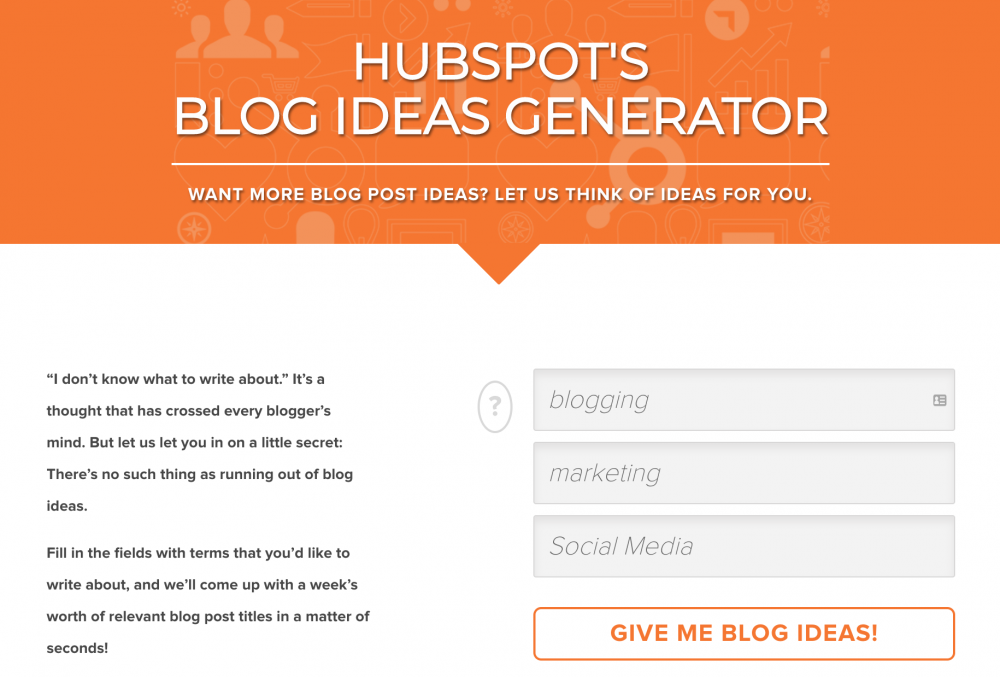
Then, the tool will generate 5 initial ideas for you to consider.
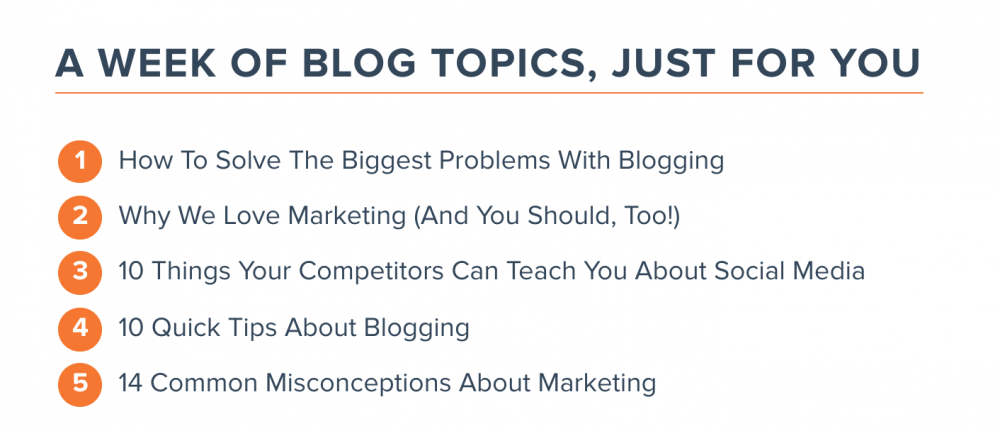
They might need tweaking to make them grammatically correct, but they give you a great start.
Portent
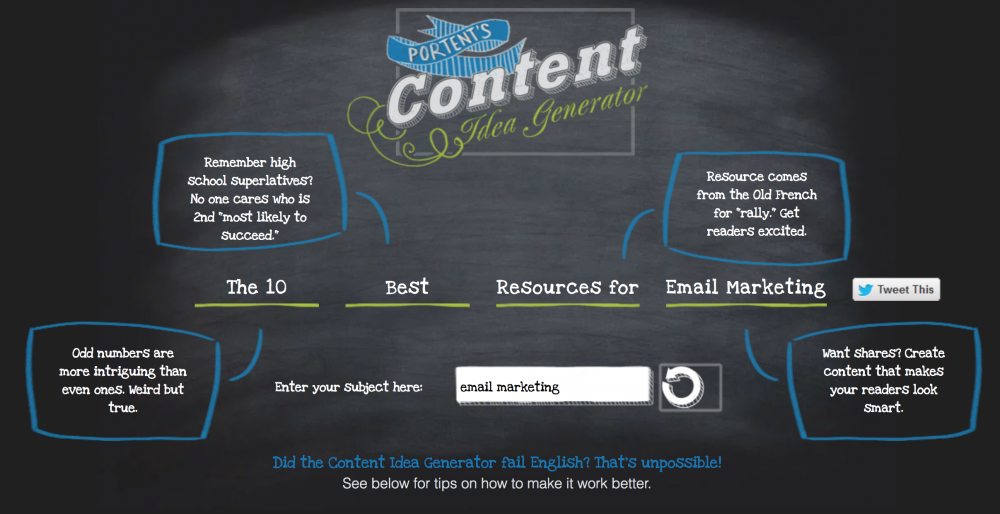
Portent is such a fun tool. You can type in any idea for your post and it will give you a possible title. Keep hitting refresh and it will keep generating ideas for you.
Book inspo
We all have book related to what we write content around, so look at the books tagline. Grabbing a book off my shelf, ‘She Means Business’ the tagline is ‘Turn your ideas into reality and become a wildly successful entrepreneur’. I could then create blog post titles from that.
- 10 steps to turn your ideas into reality
- How wildly successful entrepreneurs have made me a better person
- 6 Myths uncovered about wildly successful entrepreneurs
- Why entrepreneurship is hotter than Channing Tatum (yeah like that’s even possible!)
You can then go to the index and look at the chapter names. Do the same process with these.
Look in your blog comments
Which posts are getting most comments? Is there any subsequent posts you can write in the same area? Would there be a ‘next step’ post? Also are the comments asking you to expand on the topic? Feed these back into your content strategy so you continue to serve your audience.
Answerthepublic.com
This is an awesome site which shows you all the questions people are asking around keywords you enter.
This should give you plenty of blog posts to be getting on with! How do you brainstorm great blog topics?
If you want to get your hands on my awesome 9 sheet content planner spreadsheet
click below!

Comments 5
Great post! Super helpful 🙂
Author
Thanks
Thanks for the great tips! I’ve been struggling with coming up with blog topic ideas myself lately and I keep forgetting about Hubspot. I think I’m finally going to have to try it out.
Author
My pleasure, glad it’s helped
This is a great post and really helpful for me at the moment.
I am just starting out and I have so many ideas but sometimes need ro focus and write posts that my readers want.